The Young Author Studio
A real published author started exactly where you are: with an idea and a blank page. This studio teaches you how a book is built, gives you a proper place to type it with spelling and grammar help, helps you design your cover and artwork, and puts your finished book on our Young Authors Shelf. It is free for every family.
"My heart is inditing a good matter: I speak of the things which I have made touching the king: my tongue is the pen of a ready writer."Psalm 45:1 (KJV)
It has already been done
Tayden Franklin, published author, holding his book
Tayden Franklin is a homeschooled student who wrote his own short story, created the cover and the artwork inside it, and published it as a real paperback on Amazon. It is the kind of book you can hold in your hands, hand to your grandma, and put on a shelf.
He did not wait until he was grown up. He started with a story he wanted to tell, learned how a book is put together, typed it out, fixed it up, designed a cover, and finished it. Every step he took is taught on this page and built into the Studio, so your child can do the same thing.
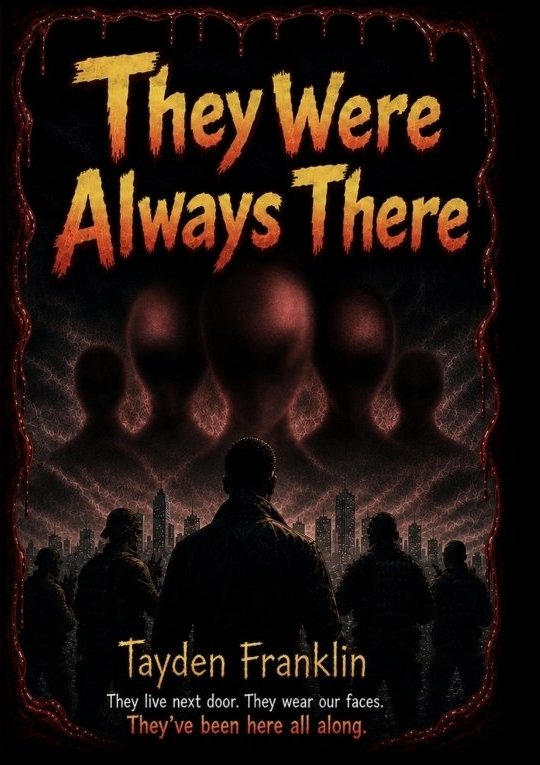
His book: They Were Always There, a science fiction short story. "They live next door. They wear our faces. They've been here all along."
From the back cover: We always thought we were alone. We were wrong. In a quiet suburb, something is not right. People are acting off. Neighbors vanish without a trace, and strange figures watch from the shadows. He is searching for answers that could change everything, but the truth he uncovers is older, darker, and far more terrifying than he could have imagined. Some doors should stay closed. Some things should stay in the dark. But they have been here all along.
The Kindle edition of They Were Always There is on Amazon now, under Tayden's own name. You can get it there, or buy the eBook right here from Psalms Paper Co.:
Get it on Amazon, Kindle $2.99
Instant EPUB download after checkout. Opens in Apple Books, Kobo, and most reader apps.
Start with the lessons
The full cover, back and front, created by Tayden
Lesson one
Open any real book and you will find the same pages in the same order, every time. That order is called the anatomy of a book. Tap each page name to see what goes on it, with a filled-in example from a pretend book called Pepper Runs Away.
The cover is the first thing a reader ever sees, and it has one job: make the right reader stop and pick the book up. It carries your title in big, clear letters, your name as the author, and one strong picture that promises the adventure waiting inside. Readers really do judge a book by its cover, so yours should show what kind of story it is at a glance.
PEPPER RUNS AWAY by Josiah Miller A painting of a small brown dog squeezing under a farm gate, one ear up, ready to run.
Lesson two
Nearly every story you have ever loved follows the same shape. Writers call it the Story Mountain. Your story climbs up one side as the trouble grows, reaches the top at the biggest moment, and comes down the other side to a satisfying end. Tap each stop on the mountain to learn what happens there.
Meet your hero in their ordinary world before any trouble starts. Show who they are, where they live, and what they love, so readers care about them when the trouble comes. Keep it short and interesting: one chapter is usually plenty.
Pepper example: Josiah feeds his dog Pepper every morning before chores. Pepper sleeps under the porch, knows every child on the road, and has never once been past the farm gate alone.
Grown-up writers talk about three acts. It is the same mountain with different names. Act One is the beginning: the setup and the moment trouble arrives. Act Two is the long middle: the rising action, the tries and failures, and the climax at the top. Act Three is the end: the falling action and the final page. If you can climb the mountain, you already understand the three acts.
Pick up any chapter book kids love and read the last line of a chapter. It almost never ends with everything calm and finished. It ends with a question, a strange sound, a surprise, or a decision, something that makes turning the page feel necessary. That is called a hook, and it is a kindness to your reader: it pulls them happily into the next chapter. Try ending your chapters with lines like these:
A scene is one piece of action in one place: breakfast in the kitchen, the search at the creek, the climb down the bank. A chapter is a bundle of one to three scenes that belong together. Start a new chapter when the place changes, when time jumps, or right after a hook lands. Short chapters are not a weakness. For young readers, short chapters feel like downhill running.
Different kinds of stories climb the same mountain, but each kind has its own habits. Learn the habits of the kind you want to write.
The hero leaves home, faces danger in a new place, and comes back changed. The pattern: a reason to go, three trials that grow harder, the biggest danger at the top of the mountain, and the journey home.
Something is missing, hidden, or strange. The hero gathers clues one by one. One clue should be a red herring, something that looks important but is not, so the truth stays surprising. The reveal comes at the climax, and every real clue gets explained by the end.
The main character is an animal, or the story stays close beside one. The animal has a real problem: lost, hungry, hurt, or needing a home. People can help or get in the way. These stories usually end warm and safe.
Choose a true story from Scripture and tell it in your own words. Keep every fact the Bible gives, exactly as God recorded it. You may fill in the sights, sounds, and feelings around those facts, but never add anything that changes what happened.
Start with an ordinary school day, then add one ridiculous problem: the class pet escapes, the science fair volcano will not stop erupting, the substitute teacher is Grandpa. The problem grows every chapter until it pops at the climax, and everybody ends up laughing, usually with a small lesson learned.
Most books mix kinds together. A mystery can happen at school. An animal story can be an adventure. Pick the pattern that fits your idea, and borrow habits from the others whenever they help.
Here is Pepper Runs Away, our pretend lost-dog adventure, mapped onto the mountain. Notice how each stop does its own job.
Lesson three
Nobody writes a book by waiting to feel inspired. Writers use tools. Here are five of the best ones. Try the Story Spark machine first: it mixes a hero, a place, a problem, and a twist into a story idea you can start today.
Press the button and get a story idea.
Do not like it? Press again. Sparks are free, and a writer only needs one good one.
Almost every story ever written started as one question. Borrow one of these, or let them teach you how to make your own.
Readers follow characters, not plots. Before you write chapter one, answer these questions about your hero. If you can answer them, your character will start making decisions on the page almost by himself.
Fresh ideas often come from putting together two things that do not seem to belong together. Write down five things you love. Pick any two. Then ask: what problem would they have if they were stuck in one story?
Telling names a feeling. Showing lets the reader feel it. Weak writing tells; strong writing shows. Look at the difference:
Josiah was scared.
Josiah's hands shook so hard that the flashlight beam danced all over the trees.
Pepper was happy to see him.
Pepper spun in circles, barking, her whole back end wagging along with her tail.
Practice: take one telling sentence from your draft and rewrite it with hands, sounds, and movement.
Stuck on a name? Borrow one. A good name is easy to say, easy to remember, and fits the kind of story you are telling.
Josiah, Caleb, Micah, Silas, Ezra, Levi, Gideon, Asa, Jonah, Seth, Tobias, Amos
Abigail, Hannah, Miriam, Ruth, Esther, Lydia, Naomi, Joanna, Phoebe, Tabitha, Grace, Hope
Cedar Creek, Willow Bend, Pine Hollow, Stonebridge, Harmony Falls, Elk Ridge, Briar Hollow, Salt Creek, Lantern Point, Miller's Crossing
Lesson four
Books come in sizes, and every size is a real book. A finished short story beats a half-finished giant every time, because finishing teaches you the whole craft: beginning, middle, end, editing, cover, and all.
| Short Story | Chapter Book | Novel | |
|---|---|---|---|
| Words | About 500 to 3,000 words | About 4,000 to 12,000 words | About 20,000 to 45,000 words for middle grade readers |
| Chapters | One piece, told straight through | About 8 to 15 short chapters | 20 or more chapters, sometimes grouped into Parts |
| The problem | One problem, one or two characters | One main problem, with smaller troubles along the way | One main problem plus subplots, smaller side stories woven in |
| Reading time | One sitting, about 5 to 15 minutes | A few sittings, about 30 to 60 minutes | Many sittings, a few hours |
| Best for | Your first finished book | Your next step as a writer | Experienced young writers with a big story to tell |
"Commit thy works unto the LORD, and thy thoughts shall be established."
Proverbs 16:3 (KJV)For parents
Here is the honest, whole process, the same steps Tayden's family used. There is no cost to use the Studio, and no cost to open a KDP account. The only money a family ever spends is on printed proof copies, which are optional but wise.
The Studio is open. Plan your book, type it with a helper watching your spelling and punctuation, design your cover, and finish with files ready for a real paperback. Free for every family, no account needed.
Open the StudioThe Young Authors Shelf is where finished books live after approval. Every book there was written by a student who started with a blank page, just like your child will.
Visit the Shelf